Looper Opening Scene Analysis

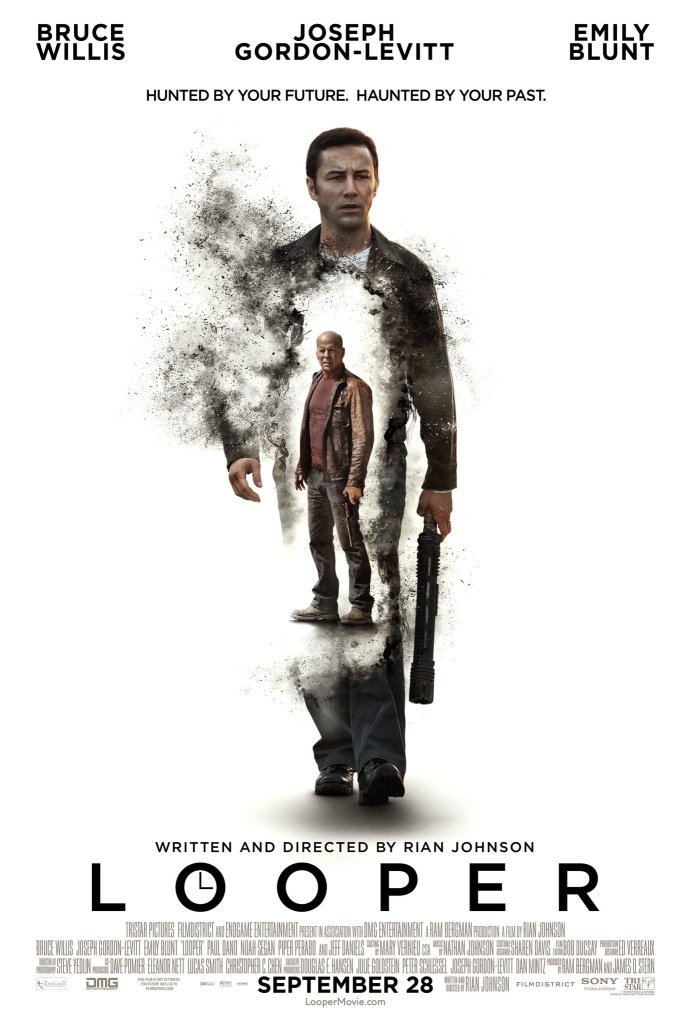
Poster for Looper

The opening to the 2012 film Looper (directed by Rian Johnson), we see what it is like to be a “looper.” For background, the film is set in the future and in the future of that future, time travel exists. In the future where time travel exists, the way the mob (to quote Scorsese’s film Goodfellas) “whacks” someone is to send them in the past (the future without time travel) where a looper kills them and disposes of their bodies. How much of this is explained in the opening?

A heaping load of none of it.

The fact that we, the audience, just see a guy pop out of thin air, screaming with a bag over his head, get shot instantly makes us confused and wonder: “what in the heck is going on?” This is because – as mentioned in the noir blog post – the audience is invested because now they want to know what in the heck is going on. This element of confusion is common in sci-fi media as well as the noir genre. Other examples of confusion being used in sci-fi media are the opening scene of The Void (which for some God forsaken reason I can’t find the opening scene on YouTube but I can find the whole movie) and the opening cut-scenes of the 2015 video game Bloodborne (which may not seem sci-fi but that comes apparent towards the end of the second act). But I digress, the confusion adds to the mystery surrounding the technological advancements, making it pair nicely with the noir genre.
The opening to Looper also shows us something that can be useful in our opening scene; it lies in how the effect of the guy traveling through time. He doesn’t dissolve in the frame, nor is there any special “glow” surrounding him as he appears; he just appears into frame. To my, it looks like they had everything stay still while they just plopped him in frame and directed him to start screaming – then in editing they just cut around him walking into frame. However, it could just be a match cut with the only difference in the set is him. Either way, this opening shows that “special” effects can be achieved through cinematography (and a little bit of editing) instead of purely the editing department or the mise-en-scene department. This helps us in deciding how to use VFX – if we need to use them.

You’ve Got Mail (aka: What Makes a Film Sci-Fi)

I know what your thinking: what does a rom-com staring Tom Hanks and Meg Ryan released in 1998 about two people falling in love over email but it real life only argue have anything to do with science fiction. Well, if you take this trip down history lane, you will soon find out.

The year is 1975, Ed Roberts (not to be confused with activist Edward V. Roberts) releases the Altair 8800; he claims this to be the worlds first personal computer (PC). It launches for $439 which, in today’s market, is worth $2,125.07 – holy Jesus, this man was the older version of Tim Cook. Since this is the first computer not used in the laboratory for stupid nerd things that only nerds need to know, people had the figure out how to use sticks and stones on that thing. And 20 years later, in 1995, Gary Kremen creates a little site (I don’t know if you’ve heard of it) called Match.com. To populate the site, Kremen made the people who worked for him, his girlfriend, and himself make profiles on Match.com. Later, his girlfriend would leave him for someone she met on Match.com; this would make him sad because his girlfriend left him for someone else, but happy because it meant his crazy little idea of people finding love online wasn’t that stupid.

Gary Kermen

Know you’re probably thinking, “Gee Kevin, this information is really obscure and poses a lot of questions: like why do know all of this information about Match.com? But you still haven’t explained why this relevant to the sci-fi genre.” Well, if You’ve Got Mail was released 3 or 4 years prior – or even before 1975 – and the plot was still the same, it would have been a sci-fi rom-com. Why? Because to people in 1974, the thing in the movie that allows them to talk to each other without them knowing who the other person is wouldn’t be called a computer, but something like Beep-Boop Box.

Image result for filthy frank cam pu tor

What I’m trying to get at here is, the time period in which a movie is made can determine if it is a sci-fi movie or not. If 1984 by George Orwell was written in 1984 (like how the movie adaptation was released in 1984), it wouldn’t a gritty dystopian showing the why Communism is bad, but some old dude over dramatically complaining about his life.

Memento Opening Scene Analysis

The opening scene for Christopher Nolan 2000 film Memento is a good example of an opening for film noir. The opening poses questions that are not answered until later in the movie. The audience has many questions: Why is this in reverse? Why is this man taking a picture of a corpse? Who is the guy with a camera? Who is the dead guy? Why did the guy with the camera kill the dead guy? These questions make the audience feel the same way I do in my biology class almost every day: really confused. Since the audience is confused, they want to figure out what in name of all things good and holy is going on. Thereby, the audience becomes invested in the film because they want to know what is going on.

Image result for memento poster
Poster of Memento

The element of confusion can be found in other noir films such as John Wick (in John Wick, we see John Wick stagger out of an SUV bloody and wounded, showing he just got out of a fight)which hooks the audience in because, unless they are insane or stupid, people do not like to be confused (as evidenced by the fact that few movies have managed to be confusing and receive praise from critics and audiences alike.) The element of confusion is something that is something of a motif in noir films because the protagonist is usually some person looking for answers (in the case of both John Wick and Memento, the questions they are trying to answer are similar: who killed a person/dog important to me.) By establishing the question/questions to the audience in the first 15 minutes of the film, they are able to piece together a plausible answer along with the protagonist. This, in turn, creates more mystery surrounding what is going on in the film and allows the audience to play detective with the detective.

What We Discussed

On Friday, January 24th, 2020, my group met at the local Dunkin Donuts to discuss in further detail what our plans are for the film we are going to create. We talked about creating a sci-fi noir that involves a simulation glitching or catching a virus and the people in charge of it send a detective and a hacker to find out who is responsible and to fix the simulation. Obviously, the two main characters will embody what their respective genre represents: the detective (noir) will be someone who prefers to work alone but is forced to work with the hacker for plot convenience, an outsider to the simulation, and more of a gritty anti-hero. Meanwhile, the hacker (sci-fi) will most likely be the antithesis of the detective so we can use the contrast between the two in order to highlight the elements of their respective genre. In the opening 2 minutes, we plan on creating a sense of suspense and mystery as they are important to both the sci-fi and noir. The setting will be at night and in an urban environment to show the noir aspects of the film. However, since we plan on using simulation theory to support the sci-fi aspects, we do not need to establish a futuristic setting as it will take place in the simulated reality. We would need a gimble to help stabilize our shots and potentially a green screen for the VFX. The intended audience for our film is nerds, people from the 90’s (as they will hopefully have found memories of watching The Matrix) teenagers and young adults. These groups of people are the most likely to see this movie and thus provide us with the most profit. We plan on platforming the film to areas that are big in the technology industry such as California and New England and if the film does well there continue to distribute it to other cities. A good way to market this film – given our main target audience is nerds – would be to give a mysterious link for them to follow on socially media and perhaps on TV ads. This would cause them to invest their time and become invested in the film; it would also build hype around it and once what is at the end of link spreads, it would be of similar effect to regular advertisements. The titles for our types of film are usually short (one or two words), bold, and with large spacing between the letters. Given that white males are usually the ones who write sci-fi movies, the protagonist tends to be American or English because writers portray their social groups. We will attempt to avoid this by hiring Fares (an Egyptian) and me (an Albanian) as actors to portray more social groups.

Film noir

(Notable media: Taxi Driver, Blade Runner, The Dark Knight, Sin City, Notorious, Memento, Drive)

Here is a good video that defines what film noir is and its conventions; this is where I got all of my new information. Defining Film Noir

Film noir is a genre of film recognized for its use of chiaroscuro – an effect created from high saturation and a monochromatic pallet – and was the main genre of film in the 1940’s and 1950’s. However, it has since become a niche genre and the new films in this genre have ditched the chiaroscuro and have been dubbed “neo-noir.” However, for the purposes of this project, I will neo-noir and film noir to be one genre as the two are largely similar (the two biggest changes are the time period and the use of chiaroscuro). Film noir, unlike sci-fi, does not have a lot of variations within its formula; most film noir films involve a detective or a private eye (this was especially apparent in when film noir was at its prime and can still be found in modern installments of the genre such as The Dark Knight) but no matter what they are, the main character ends up in a worse place then where they started. This “worse place” can be a lot of things: sometimes they are a little more insane in the end than in the beginning (such as the case in Taxi Driver), other times they lose someone who was important to them (Memento), or sometimes they just die at the end (The Dark Knight trilogy). Another important aspect of noir is the time period the film takes place in. This is important because the time period influences the thematic focus of the film; which becomes apparent when comparing movies like Notorious – which came out in 1946 and has an anti-fascist theme because of WWII – and Taxi Driver – which as anti-war themes because of the draft and the Vietnam War.

Types of Sci-fi

There is a myriad of subgenres in sci-fi: you got the robots, simulations, aliens, aliens that make you go insane if you look at them, and the good ol’ “everything is wrong how did we get here” subgenre. These subgenres usually intertwine while still being able to stand out. For the example, The Matrix is a mixture of simulation theory – the remains of the human race live in a simulation – and dystopian – because the real reality is nightmarish. The fact the sub genres are usually mixed together can make it difficult to find sci-fi movies that are strictly one subgenre, but it does narrow the amount of research while also allowing more creativity since the directors, cinematographers, director of photography, etc. do not need to worry about confining to one specific style. Each genre, however, has unique qualities that make it easy to identify what subgenres a film belongs to. Some of these subgenres are alien, cyberpunk, dystopian, Lovecraftian horror (this subgenre belongs both sci-fi and horror), simulation theory.

Alien

Notable media: Alien, Predator, The Thing, E.T. the Extra-Terrestrial

As the name suggests, this subgenre involves aliens (what a shocker). The aliens are usually end up on Earth but on some instances humans find themselves on alien planets. Xenophobia and how we see outsiders are often hot topics in alien movies.

Cyberpunk

Notable media: Blade Runner, Ghost in the Shell, Akira, Robocop

This subgenre is often, if not always, set in the future and a trademark of it is artificial limbs/implants. Cyberpunk often questions the boundaries between man and machine which is shown in many ways such as giving AI the desire to be more human such as in Ghost in the Shell where The Puppet Master (the antagonistic AI) tells Major Motoko Kusanagi that he/she/it desires to have the ability to reproduce and die. Another characteristic of the cyberpunk is the setting which is usually a massive city in the future with ads and technology everywhere. When politics is involved, cyberpunk movies tend to be anti-capitalist.

Dystopian

Notable media: A Clockwork Orange, The Matrix, V for Vendetta, 1984

Dystopian movies can be summed with a question: how did the government get so much power? While some dystopian films do not involve the government (see The Matrix), they often involve some higher power being oppressing the masses. These movies usually take place in the future (relative to the source material/movie) and are usually very anti-communist.

Lovecraftian horror

Notable media: The Void, Annihilation, Bloodborne (video game), Dagon (short story)

Lovecraftian/cosmic horror – my personal favorite subgenre of both sci-fi and horror – is similar in premis to the alien subgenre: some other worldly being is within our boundaries. However, Lovecraftian is a little more specific than that – the “aliens” that invade us are more akin to gods (especially in H.P. Lovecraft’s writings such as Dagon) and we, as humans, cannot fathom such beings so we either cannot see them or go insane in their presence. This previous statement clearly shows why there are few Lovecraftian horror movies (and even fewer good ones), it cannot be created in a visual medium. How do you show something that, once seen, makes those who see it go insane?

Simulation Theory

Notable media: The Matrix, Ready Player One, Inception

The simulation subgenre focuses on the idea that we are currently living in a simulation “unbeknownst” to us. This subgenre mostly takes in place in a simulation but usually shows what the world outside the simulation is like and usually has themes of our lives being out of our hands.

Introduction

Hi, my name is Kevin Foughty and this is my blog for part of my AICE Media Studies final in which we create an opening for an original film. My group (Susan Hammond, Nicholas Gray, and Fares Eltoukhy) and I, plan on making a film that is a mix between the sci-fi and noir genres; hopefully the result is a movie similar to The Matrix or Blade Runner. In case you want to know more about me and my film going habits, my favorite genres are horror (recommendations: Evil Dead 2, The Thing, and The Texas Chainsaw Massacre) sci-fi (recommendations: Ghost in the Shell, Spaceballs, The Iron Giant,) mainly because both of these genres are diverse; with horror you can watch a found footage movie or a slasher flick and with sci-fi you can watch a movie about simulations or a movie about how bad the future will be. Since sci-fi is such as broad genre, my group and I felt it would be easier to do then some other genres as there are different options we can take each with their own conventions. For example, if we decided to do a film in the dystopian sub genre, we wouldn’t have to worry about showing spaceships flying or aliens invading since they are not a convention of the dystopian subgenre (which are oppressive government that is usually socialist and the rights of the people being stripped away). We chose the noir part because it can blend well with the sci-fi genre as evidenced with films such as The Matrix and Blade Runner due to the mystery surrounding surrounding the technology that is frequent in the sci-fi movies and mystery solving nature of the noir genre. Well, just like Darth Helmet and his crew did in Spaceballs, let’s go straight to “ludicrous speed.”

Design a site like this with WordPress.com
Get started